
Urchin Uprising: A Synchronized Spectacle of Salmacis virgulata (L. Agassiz in L. Agassiz & Desor, 1846) at a near-shore Artificial Reef off the southeast coast of India
Afreen Hussain, Arulmohan Rathinasamy, A Sakthivel, Kasim H. M,
Punit Dhandhania
Kuddle Life Foundation, 29, Montorsier St, White Town, Puducherry, 605001.
Abstract
This study documents the first observed mass aggregation of the common sea urchin, Salmacis virgulata, at an Artificial Reef off Puducherry. Observed during dives in September-October 2024, thousands of sea urchins were seen moving over soft sediment, covered in shell fragments. Factors influencing this behaviour may include food availability, environmental changes, spawning activities, predator avoidance, and habitat disturbances. S. virgulata exhibits a broadcast spawning strategy, synchronizing reproductive efforts while minimizing predation risk. The findings contribute to the limited understanding of S. virgulata’s ecology and behaviour in the southeast Indian marine environment.
Keywords: Sea urchin; Artificial Reefs; Mass aggregation; Behaviour; Puducherry.
Introduction
Sea urchins are essential to marine ecosystems, shaping biodiversity, habitat dynamics, and overall ecological balance, especially in coral reef and seagrass ecosystems (Bruckner et al., 2003; Fong et al., 2024). Salmacis virgulata commonly called regular sea urchin is found in shallow coastal waters of the Indo-Pacific region, including India (Clark & Rowe, 1971). It is also the most common sea urchin reported from Pondicherry and other parts of the southeast coast of India (Satheeshkumar, 2011; Mariasingarayan et al., 2024). It plays a vital ecological role by grazing on algae, controlling algal growth, and contributing to the nutrient cycle in marine ecosystems (Bruckner et al., 2003, Raghunathan and Venkataraman, 2012). This species is also known for its distinctive covering behaviour, a type of crypsis, where individuals attach shell fragments, debris, and other materials to their spines (Kehas et al., 2005; Dumont et al., 2007). This behaviour serves several ecological functions like protection from predators (Dayton et al., 1977), protection from mechanical damage (Richner & Milinski, 2000; Dumont et al., 2007), UV shielding (Belleza et al., 2012), hydrodynamic stability (Cohen-Rengifo et al., 2018), and acting as a food source (Ziegenhorn, 2017).
- virgulata is primarily an herbivorous grazer, feeding on macroalgae, seagrasses, and detritus (Pearse 2006). Its feeding activity helps regulate algal populations in coral reef and seagrass ecosystems (Carpenter,1988; Fong et al., 2024). Despite its protective spines and covering behaviour, S. virgulata faces predation from various marine species, including fish, crustaceans, molluscs, sea stars, etc. Another behaviour commonly seen in sea urchins is aggregation which is known as the presence of three or more individuals in a group (Alvarado, 2008). Such aggregations can occur due to various factors, including synchronized spawning, feeding (Lauzon-Guay et al., 2007), or collective defence against predators (Yu et al., 2022). However, research on the ecology and behaviour of S. virgulata remains limited (Saravanan et al., 2017).
This study describes the observation of mass aggregation of the common sea urchin Salmacis virgulata at an Artificial Reef off Puducherry. To the best of our knowledge, this is the first documented record of a mass aggregation of S. virgulata observed in situ off the coast of southeast India.
Material and methods
Study area
Mass aggregation of common sea urchin, Salmacis virgulata was observed during a regular dive in the Artificial Reef located at Chinna Mudaliyarchavadi, Villupuram (Pondicherry bioregion) located 11°58’11.58″N and 79°52’3.24″E during September-October 2024. The reef is a relatively new reef, deployed 1.5 years ago by the Kuddle Life Foundation and composed of 260 concrete modules at a depth of ~15m. Reef bottom is a hard firm ground, dominated by soft sediment, with no macroalgal growth during the time of observation. Photography and videography were recorded using underwater cameras (Olympus TG6, Insta360). The urchin was identified using standard keys (James, 2008; https://www.marinespecies.org/)
Results and discussion
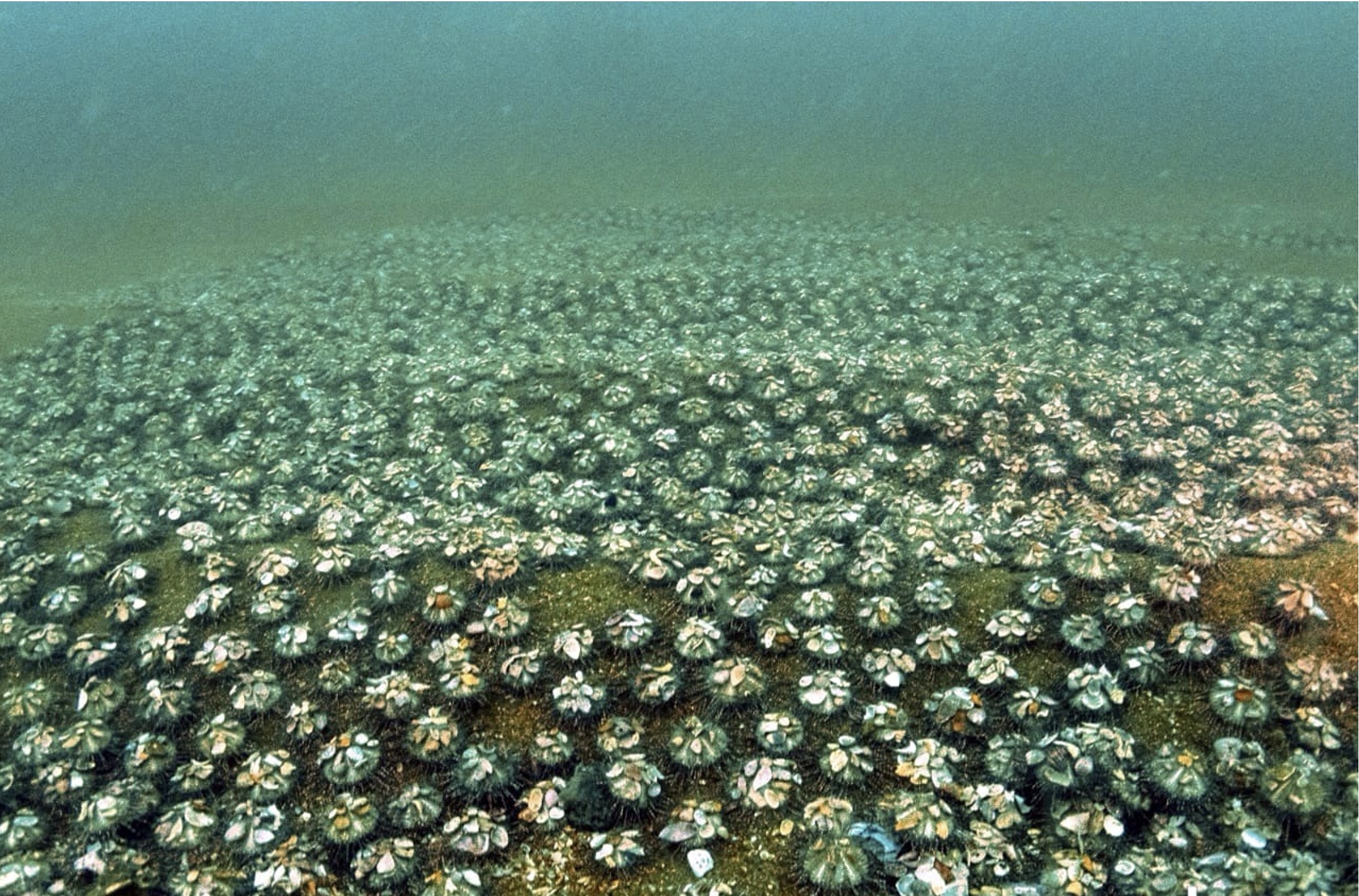
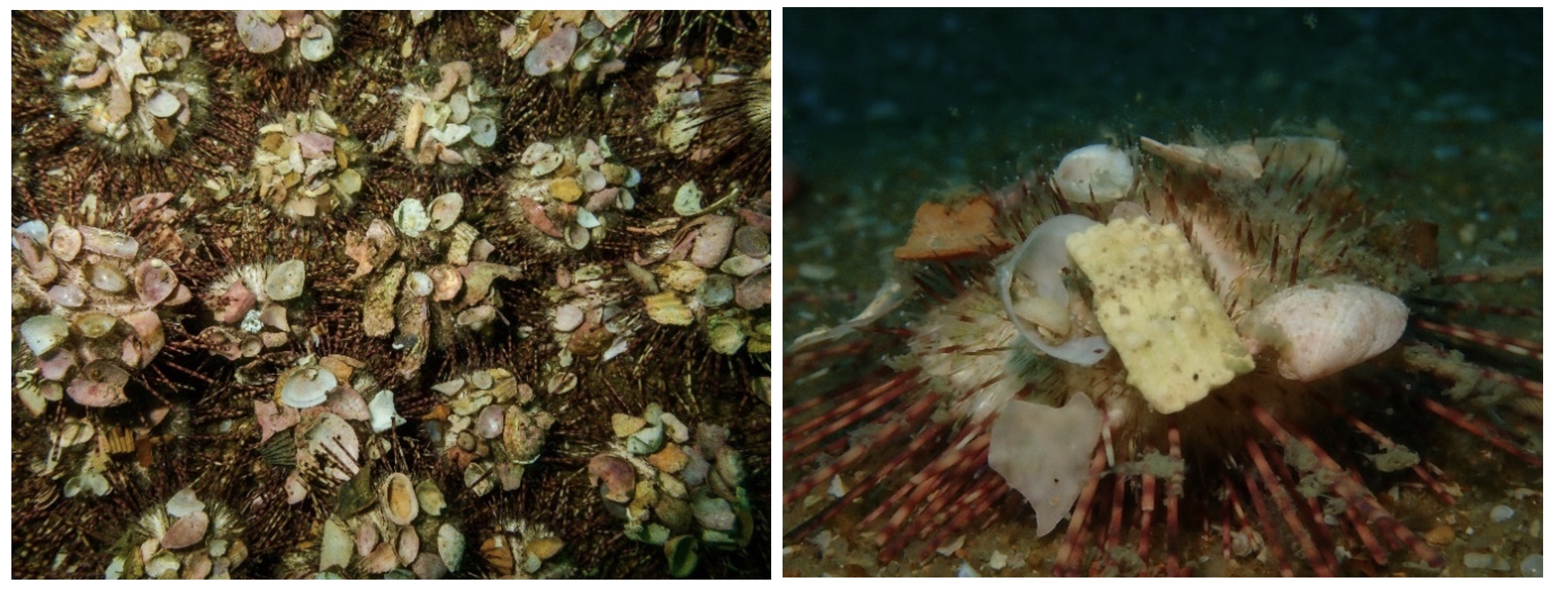
Mass aggregation of common sea urchin, S. virgulata was observed during a regular dive in the Artificial Reef. An aggregate of thousands of sea urchins was seen moving over the soft sediment, between the cluster of modules (Fig 1). They were covered with broken shells, fragments of bivalves, etc (Fig 1). Members of genera Salmacis have been reported to cover themselves significantly more in response to light, to limit UV exposure, particularly UV-C (Belleza et al., 2012). The urchins had their spines extended and the locomotion was faster than normal days. This corroborates with the findings of Zhadan et al., (2021), who reported an increased locomotion rate of the broadcast spawners sea urchins Strongylocentrotus intermedius and Mesocentrotus nudus before and during the spawning event. Recent field studies indicate that higher phytoplankton concentrations enhance both pre-spawning movement activity and spawning in male S. intermedius sea urchins (Zhadan et al., 2018). No juveniles were observed in the vicinity; however, some bannerfish and triggerfish were seen feeding off the urchins.
Some of the reasons for mass aggregation are discussed below:
- Food Availability – They might be moving towards a new feeding ground, following the food cues, especially if their usual food sources (like algae or seagrass) are depleted (Sun et al., 2021).
- Environmental Changes – Factors like temperature shifts, oxygen levels, or water currents could trigger mass movement (Traiger, 2019).
- Spawning Behavior – Some sea urchins synchronize their movements to spawn together, increasing reproductive success (Wahle & Peckham, 1999).
- Predator Avoidance – If a predator (like a triggerfish or octopus) is nearby, they might be escaping to a safer area.
- Disturbance or Habitat Change – If there was a recent storm, human activity, or changes in sedimentation, they could be relocating.
S. virgulata follows a broadcast spawning strategy, where large numbers of individuals release eggs and sperm into the water simultaneously (Saravanan et al., 2016). This synchronized spawning typically occurs during the northeast monsoon season, with reproductive peaks recorded in February, April, and September in the Gulf of Mannar (Saravanan et al., 2016). By spawning in large groups, the urchins increase fertilization success and reduce individual predation risk. Environmental cues such as water temperature, lunar cycles, and tides are believed to trigger these spawning events.
PC @ Dr. Daniela Munari
Figure 1: Mass aggregation of Salmacis virgulata at the CMC Artificial Reef
Conclusion
While the exact purpose of this aggregation remains uncertain, it could be linked to environmental cues, reproductive cycles, or predator avoidance. Further studies on its behaviour and population dynamics at the CMC Artificial Reef could provide deeper insights into its breeding, threats, and ecological significance.
Data availability: Video must be added
Acknowledgements
The authors would like to thank the dive team including Rehaan Khan, Amrita, Naveen and the Umeed Mistry, Dr. Daniela Munari, and Pooja Sampath for photography and video evidence.
References
- Agassiz, L., & Desor, É. (1847). Catalogue raisonné des familles, des genres et des espèces de la classe des échinodermes (Vol. 3). Martinet.
- Alvarado, J. J. (2008). Seasonal occurrence and aggregation behavior of the sea urchin astropyga pulvinata (Echinodermata: Echinoidea) in Bahía Culebra, Costa Rica1. Pacific Science, 62(4), 579-592.
- Belleza, D. F. C., Abao, R., Taguba, C. A., & Dy, D. T. (2012). Effects of UV-C on the masking behavior of the green urchin Salmacis sphaeroides (Linnaeus, 1758). The Philippine Scientist, 49, 34-43.
- Bruckner, A. W., Johnson, K. A., & Field, J. D. (2003). Conservation strategies for sea cucumbers: Can a CITES Appendix II listing promote sustainable international trade?
- Carpenter, R. C. (1988). Mass mortality of a Caribbean sea urchin: immediate effects on community metabolism and other herbivores. Proceedings of the National Academy of Sciences, 85(2), 511-514.
- Clark, A.M.G. & Rowe, F.W.E. (1971) Monograph of Shallow-water Indo-West Pacific Echinoderms. British Museum Natural Hstory Publications, London, 238 pp.
- Cohen-Rengifo, M., Agüera, A., Detrain, C., Bouma, T. J., Dubois, P., & Flammang, P. (2018). Biomechanics and behaviour in the sea urchin Paracentrotus lividus (Lamarck, 1816) when facing gradually increasing water flows. Journal of Experimental Marine Biology and Ecology, 506, 61-71.
- Dayton, P. K., Rosenthal, R. J., Mahen, L. C., & Antezana, T. (1977). Population structure and foraging biology of the predaceous Chilean asteroid Meyenaster gelatinosus and the escape biology of its prey. Marine Biology, 39, 361-370.
- Dumont, C. P., Drolet, D., Deschênes, I., & Himmelman, J. H. (2007). Multiple factors explain the covering behaviour in the green sea urchin, Strongylocentrotus droebachiensis. Animal Behaviour, 73(6), 979-986.
- Fong, C. R., Smith, N., Catalan, E., Caraveo, B. A., Barber, P. H., & Fong, P. (2024). Herbivorous sea urchins (Echinometra mathaei) support resilience on overfished and sedimented tropical reefs. Scientific Reports, 14(1), 3829.
- James, D. B. (2008). A field guide for identification of common echinoderms of the Gulf of Mannar. Training manual on GIS and marine biodiversity. Chennai, India: Loyola College, 231-253.
- Kehas, A. J., Theoharides, K. A., & Gilbert, J. J. (2005). Effect of sunlight intensity and albinism on the covering response of the Caribbean sea urchin Tripneustes ventricosus. Marine Biology, 146, 1111-1117.
- Lauzon-Guay, J. S., & Scheibling, R. E. (2007). Behaviour of sea urchin Strongylocentrotus droebachiensis grazing fronts: food-mediated aggregation and density-dependent facilitation. Marine Ecology Progress Series, 329, 191-204.
- Mariasingarayan, Y., Jagadeesan, V., Danaraj, J., Murugan, M., & Palanivel, P. S. (2024). Seasonal diversity of echinoderms from Rameswaram Island, Palk Bay, Southeast India. Regional Studies in Marine Science, 77, 103705.
- Pearse, J. S. (2006). Ecological role of purple sea urchins. Science, 314(5801), 940-941.
- Raghunathan, C., & Venkataraman, K. (2015). Coral Reef Associated Macrofaunal Communities of Rutland Island, Andaman and Nicobar Archipelago. In Marine Faunal Diversity in India (pp. 121-135). Academic Press.
- Richner, H., & Milinski, M. (2000). On the functional significance of masking behaviour in sea urchins an experiment with Paracentrotus lividus. Marine Ecology Progress Series, 205, 307-308.
- Saravanan, R., Jawahar, P., Francis, T., Ahilan, B., Santhakumar, R., & Anand, A. (2016). Studies on the Influence of Abiotic Factors in the Gonadal Index of Sea urchin Salmacis virgulata from the Gulf of Mannar, South East Coast of India. Indian Journal of Science and Technology, 9(2), 1-5.
- Saravanan, R., Jawahar, P., Francis, T., Ahilan, B., Santhakumar, R., & Gopakumar, G. (2017). Echinoid landings at Mandapam, South-east Coast of India with a note on gonadal maturity of two species of sea urchins. Indian Journal of Fisheries, 64, 190-193.
- Satheeshkumar, P. (2011). First record of regular sea urchin Salmacis virgulata (L. Agassiz and Desor 1846) from the Pondicherry Coast, India. World journal of fish and marine sciences, 3(2), 126-128.
- Sun, J., Zhao, Z., Zhao, C., Yu, Y., Ding, P., Ding, J., … & Chang, Y. (2021). Interaction among sea urchins in response to food cues. Scientific Reports, 11(1), 9985.
- Traiger, S. B. (2019). Effects of elevated temperature and sedimentation on grazing rates of the green sea urchin: implications for kelp forests exposed to increased sedimentation with climate change. Helgoland Marine Research, 73(1), 5.
- Wahle, R. A., & Peckham, S. H. (1999). Density-related reproductive trade-offs in the green sea urchin, Strongylocentrotus droebachiensis. Marine Biology, 134, 127-137.
- Yu, Y., Sun, J., Chang, Y., & Zhao, C. (2022). High fitness areas drive the aggregation of the sea urchin Mesocentrotus nudus. PeerJ, 10, e12820.
- Ziegenhorn, M. A. (2017). Sea urchin covering behaviour: A comparative review. Sea Urchin Covering Behavior: A Comparative Review, 19-33.
- Zhadan, P. M., Vaschenko, M. A., & Ryazanov, S. D. (2018). Assessing the effect of environmental factors on the spawning activity of the sea urchin Strongylocentrotus intermedius through video recording observations. Marine Ecology Progress Series, 588, 101-119.
Zhadan, P. M., Vaschenko, M. A., & Permyakov, P. A. (2021). Quantitative study of the behavior of two broadcast spawners, the sea urchins Strongylocentrotus intermedius and Mesocentrotus nudus, during mass spawning events in situ. PeerJ, 9, e11058.
Your support matters!
Help us reach more people. Share this post with your friends!